What Gen Z Gets About Dating That We're Still Learning

A Today Show segment stopped me mid-coffee. And what came out on the other side was not advice. It was a mirror.
by: Yvette Valdenegro

The Today Show ran a segment on Gen Z and dating. It was the kind of segment that sneaks up on you. You start watching to be entertained, maybe a little amused, and then somewhere around the third talking point you realize you've gone very still. Because you're not watching them. You're watching yourself... or the version of yourself that never had permission to do what they're doing so openly.
Let's be honest. The first instinct when we see Gen Z talk about green flags, emotional availability, and asking someone their attachment style on the second date is to laugh. Or roll our eyes a little. Or say something like, "That's cute, but wait until life happens." And there's something real in that response. But there's also something worth examining because that instinct to dismiss? That's worth sitting with.

They Named the Thing. That's Not Small.
Gen Z didn't invent emotional unavailability. They didn't invent ghosting, situationships, or the slow fade of someone who was never fully present. What they did do is name it. Out loud. In public. Without apology. They coined "ghostlighting" — when someone disappears and then comes back acting like nothing happened. They normalized saying "I'm in therapy" as a green flag, not a confession. They talk about emotional labor the way previous generations talked about splitting the bill, practically, matter-of-factly, as a thing that simply must be discussed.
That's not immaturity. That's vocabulary. And vocabulary changes what becomes possible.
For a lot of women, especially women who built entire identities around being low-maintenance, easy, adaptable, undemanding, watching a generation name their needs with that kind of fluency feels almost foreign. Not wrong. Foreign. Like hearing someone speak the language you always understood but never learned to say out loud.
The Part Where They're Right
They are done with ambiguity for sport. They've collectively decided that "we're just vibing" has an expiration date and when it expires, you name what's happening or you part ways with clarity. They are, as one relationship researcher put it, choosing emotional return on investment over romantic chaos. They want consistency, communication, and reciprocity. They're not willing to decode someone. They want to be met.
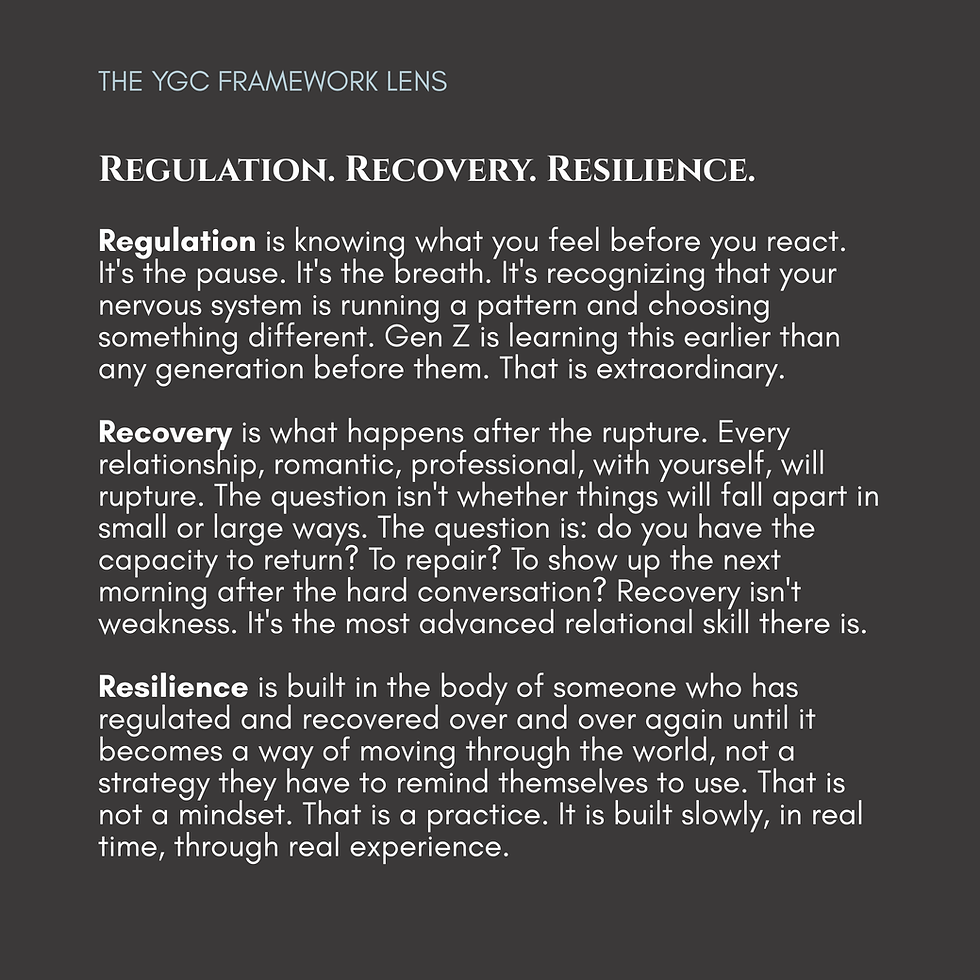
That is deeply healthy. That is, in fact, what the YGC framework talks about every single time the conversation turns to self-mastery and relationships: you cannot give what you haven't built. You cannot show up regulated for someone else if you've never learned what regulation feels like in your own body. Gen Z is, whether they're using that word or not, talking about regulation. They're building it into the criteria before they even say yes to a first date.

That is a framework shift. That is not a dating trend. That is a generational redefinition of what it means to be relationship-ready and it starts with self, not with finding the right person.
But Here's the Learning Curve They're Still On
Gen Z is extraordinarily good at the language of emotional intelligence. And language matters. But language and lived embodiment are different rooms in the same house, and knowing the words doesn't always mean you've walked through the door.
There's a version of "I know my green flags" that becomes a checklist so rigid it keeps out anyone who doesn't present themselves in the exact format you've pre-approved. There's a version of "I know my boundaries" that is actually avoidance dressed up in the right vocabulary. There's a version of "we're done if this isn't clearly defined by date three" that is less about clarity and more about not letting anyone close enough to actually disappoint you.
Regulation without recovery is just control. And resilience, the real kind, not the performance of it, requires that you've actually been through something, felt it fully, and found your way back. That part? Takes time. Takes friction. Takes the kind of experience that cannot be intellectualized. It has to be lived.
Can There Be Balance?
Yes. And the balance doesn't look like meeting in the middle of two extremes. It looks like integration.
It looks like holding Gen Z's clarity about needs while also holding older generations' hard-won knowledge that love is not a series of criteria being met...it's a living, shifting, sometimes uncomfortable practice of choosing someone through seasons, not just moods. It looks like bringing their vocabulary to experiences that used to be nameless. It looks like letting their emotional honesty challenge the places where we performed okayness for so long we forgot what our actual okayness sounds like.
For women specifically: women who built their strength around being capable, adaptable, needed, this is the specific invitation. Not to become Gen Z. Not to start asking for attachment style assessments on a Tuesday afternoon. But to ask the quieter question underneath all of it: what would it feel like to be as honest with yourself about what you actually want as they are?

What We Can Learn From Them And Offer Back
They can teach us to name things. To stop performing okayness. To exit situations that are fundamentally misaligned without needing to make a dramatic case for why. To treat emotional maturity as a requirement, not a bonus. To build from a centered self rather than a starving one. They can remind us that "I don't know what I want" is a decision and that clarity, while uncomfortable to pursue, is a form of radical self-respect.

And in return, we can offer them the thing that only time and lived experience provides: the understanding that even two regulated, boundaried, emotionally literate people will still confuse each other sometimes. Will still make choices that don't make sense in retrospect. Will still need repair more than they need perfection. The work isn't in constructing the right situation before you enter. The work is in who you become inside the experience.
Community matters here too. The data shows Gen Z is moving back to real-life, curated spaces to meet people like run clubs, creative collectives, shared gatherings. They figured out that apps optimized for volume, not depth. They're looking for environments that naturally grow connection. That is, in the most literal sense, what YGC was built for - curated, intimate, invitation-based spaces where women can show up fully and meet one another in real life. The instinct is right. The technology was just never the point.
Who Do You Want to Be?
This is not a list of things to do differently. This is not a dating guide. This is an invitation to watch a generation that is building emotional infrastructure in public, with all the growing pains and overcorrections that entails, and to ask yourself what they might be reflecting back.
Where are you still performing okayness in a relationship with yourself? Where have you been vibing when you actually wanted clarity? Where did you learn that needing things was too much and is that still true? Where could your own regulation, recovery, and resilience use a little more honest attention?
Gen Z didn't get it all figured out. Neither did we. But somewhere between their vocabulary and our experience, there's a version of love... romantic, self-directed, communal, that is more honest than what most of us were handed as a template.
That version is worth building. At any age. In any season.

Comments